They say sales is just a numbers game.
The more sales opportunities you put into your pipeline, the more revenue you'll make, right?
If only. In reality, each opportunity a sales team pursues takes up valuable resources, and if that deal doesn't pan out, those resources were wasted.
The dream scenario would be that you could not only find deals that are more likely to close and deliver revenue, but also accurately predict that revenue through sales forecasting.
A qualification process is essential to a company that wants to maximize sales revenue by picking more winners and avoiding more losers.
One of the most trusted frameworks for doing this is a sales qualification methodology called MEDDIC. The MEDDIC sales process promises to not only lead to more revenue for sales teams, but also offer more accurate sales forecasting for any given time frame.
We'll look at MEDDIC as a sales methodology and explain how you can use the sales process to create a more accurate sales forecast and make better decisions.
What Is MEDDIC All About Anyway?
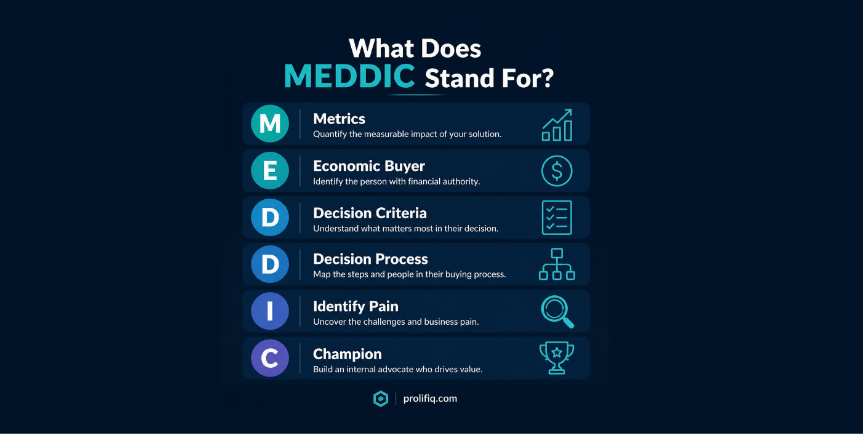
MEDDIC is a handy acronym that fortunately doesn't have anything to do with the medical industry. It stands for:
- Metrics
- Economic Buyer
- Decision Criteria
- Decision Process
- Identify Pain
- Champion
(We think the acronym is a little forced, but we'll roll with it.)
The idea behind MEDDIC is simple: help sales teams better qualify potential customers and waste fewer resources pursuing opportunities that aren't worth the effort, or aren't likely to close.
It all goes back to the idea that much of sales success involves choosing the right targets. In other words, if you win or lose a deal, it isn't just about your pitch, or your business case, or any other selling motion; it may also be because you went after the right (or wrong) customer.
What makes for a "right" or "wrong" customer has nothing to do with whether or not you won the deal. (Saying "it was the right customer" because they paid you money may be technically true, but it doesn't do much for the long run. Maybe you just got lucky.)
A "right" customer is someone who fits the profile of an organization with the means to buy what you're selling, the need for it, and the interest in it. When those three qualities align, you win, assuming you were persuasive enough to convince them.
MEDDIC helps you predict which customers will be the "right" customers to pursue, the ones worth spending valuable time and money to obtain. The more you chase after accounts in this pool, the more likely you are to hit your numbers, to the point where you can be more selective with which deals you're working. The MEDDIC sales methodology drives consistency in how your team prioritizes deals, engages stakeholders, and brings other resources alongside them to capture the customer.
In this sense, sales isn't "just a numbers game." More doesn't necessarily result in more.
Let's look at each component of MEDDIC.
Metrics
Metrics are ways to determine success and worth.
These are often called key performance indicators (KPIs). However, while all KPIs are metrics, not all metrics are KPIs.
Whatever you call them, metrics are important because they're how customers evaluate the economic benefit they'll receive from your product or service.
Whether it's in increased product demos, quicker sales cycles, lower employee churn, shorter time to market, higher website traffic, or anything else you can put a number to, metrics are things your solution needs to meet, or be likely to meet, if a customer is going to be interested.
What you and other sales pros want to do with metrics is:
- Understand what the customer values the most, so you can tailor your pitch to them, and
- Determine if your product or service can meet customer expectations of performance
Metrics aren't magic, but they are helpful in selling and forecasting future sales. If you can understand and communicate value here, you're more likely to do so with similar customers in the future.
Economic Buyer
We think the term "economic buyer" is a bit redundant, after all, aren't all buyers economic?
Redundancy aside, an economic buyer is the contact inside the company who has the actual, real power to authorize spending.
This person is considered a type of decision-maker, but note that the person controlling the purse strings and the ultimate yes-or-no decider may not be the same person. This is where understanding customer roles within the real hierarchy of a company (as opposed to a simple, one-dimensional org chart) is essential.
It's crucial to understand the economic buyer's needs, priorities, and mindset. If at all possible, you'll want to have conversations with them about the metrics they use to evaluate whether or not they should agree to a deal, any expectations they have, and how they're involved in the overall buying process.
Ensuring that sales teams are identifying buyer types within your CRM will enable you to use data in future pursuits as a means to proactively get multi-threaded with the right buyer types. You can leverage this data to understand which personas are involved in deals that are won versus lost, the number of stakeholders you need to engage in a pursuit to win, or how many supporters and champions are on your side and the win rates associated with that metric.
Decision Criteria
This component is important to understand because it provides a blueprint on how the company makes decisions about solutions and the vendors who provide them.
Deals are competitive. Chances are, any situation where a business is considering a solution will have more than one vendor in the mix. They have to compare and contrast all of these competitive options to figure out which they should choose, which means if you grasp the criteria they use, you can help them make the right choice.
The list of possible criteria a business can use is a mile long. Criteria can range from budget constraints and projected ROI to how easy the solution is to use, total implementation and integration time, and how well the solution plays with their current infrastructure.
Criteria exist whether or not the company has a formalized, by-the-book decision-making process. Criteria also may vary from business unit to business unit, or even team to team within the same business unit.
In short, you want to know what they think is important so you can show them you meet all the criteria and should be the logical choice.
Decision Process
Closely related to the above is the process buyers use to make the decision and give you a green light or a red light.
Understanding how the gears turn and lead to a yes-or-no conclusion makes you more likely to succeed. It also makes you more likely to avoid the deal stagnating and hanging out in limbo. You'll know who to contact and win over, what timeline you'll need to meet, which legal requirements need to be fulfilled, and a dozen other hurdles to surmount in order to close.
Again, a company may not have a formalized process. Uncovering whatever process they use, even if it's an informal one, takes a bit of detective work.
Identify Pain
Before a customer buys a solution, they need to have a problem. And you need to know what that problem is.
Identifying the customer's pressing need, or pain, is vital. Without it, you won't make a sale. And even if you know of a pain, that doesn't mean the issue is the customer's only or even most important need.
There are a ton of ways that a customer's pain point can make itself known. The more specific you can define it, the better you can tailor your pitch. For example, "we're losing money" isn't as good as "we are losing $500,000 per quarter because our production tempo is 25% slower than optimal."
The goal here is to identify and define the pain and connect that critical need to a solution in a crystal clear way. Sales reps can't make their pitch compelling if they don't make it appropriate to their target account's urgent dilemma.
Champion
Finally, a sales team needs to know if they have a hero inside the account who's going to slay some dragons for them.
In other words, it's important to identify champions: the contacts who have the influence with decision-makers to open doors and win over leadership.
Champions don't usually have final decision-making authority, but even if they don't, they're still integral to the sales process. They know important people, and important people respect them. When they talk, buyers listen. When they knock on doors, those doors open.
With luck, you have an insider who will help carry you along the sales process. They won't make the sale for you, but with a really great champion by your side, it'll seem like they did.
Needless to say, if you can find someone invested in your solution and committed to its success, your odds of winning the deal go way up.
Who Created MEDDIC?
MEDDIC was created in the 1990s at PTC, one of the most successful enterprise software companies of its era, as a way to scale a complex sales motion predictably. It was built around a simple idea: qualify ruthlessly, know your deal cold, and align every stakeholder around real value rather than gut feel.
That original framework has since evolved. Sales teams later added a second C for Competition (MEDDICC), and some added a P for Paperwork Process (MEDDPICC) to account for how enterprise deals get stuck in legal and procurement. The core qualifying philosophy behind all three versions is the same.
MEDDIC vs. MEDDICC vs. MEDDPICC: What's the Difference?
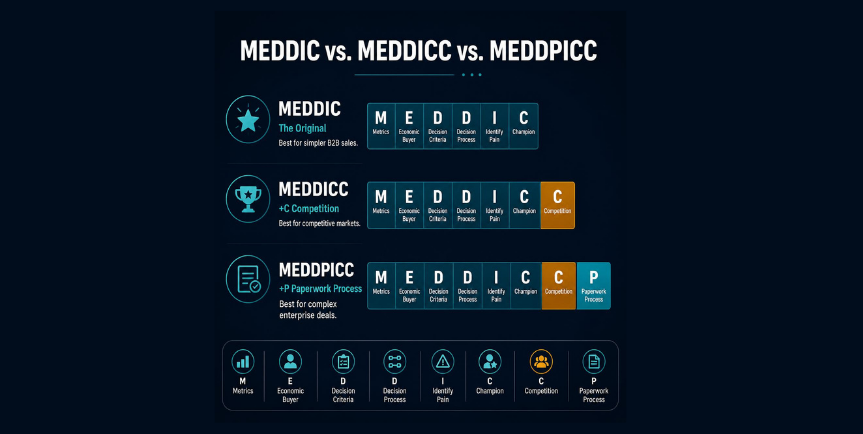
You may have heard of two variations on MEDDIC: MEDDICC and MEDDPICC. Here's how the three compare.
FrameworkWhat it coversBest forMEDDICMetrics, Economic Buyer, Decision Criteria, Decision Process, Identify Pain, ChampionSimpler B2B sales with fewer stakeholdersMEDDICCMEDDIC + CompetitionCompetitive markets where differentiation mattersMEDDPICCMEDDIC + Competition + Paperwork ProcessComplex enterprise sales with legal and procurement involved
Both MEDDICC and MEDDPICC add a C for Competition. In competitive markets, sales reps need to uncover:
- What other companies are in the mix for this business?
- How do we think we stack up against them?
- How does our customer think we stack up against them?
- What is our one main advantage over the competition in play?
MEDDPICC goes one step further and adds a P for Paperwork Process. This is used in enterprise deals where there's a very real danger of the deal getting snagged on paperwork and red tape as you near the closing stage. You'll ask questions like:
- What needs to be signed before we close, and who needs to sign it?
- Is there a procurement department or contracting team we'll need to work with?
- What legal issues will we need to navigate?
Overall, MEDDIC (in any of its forms) is a useful way to qualify potential customers and see if they meet the criteria that'll lead to a successful venture. A target account may not check all of these boxes, but that doesn't mean the opportunity isn't viable. The more you understand what has worked well for you in the past, the better you can use MEDDIC to inform the future.
If you're weighing MEDDIC against a lighter framework, see our breakdown of MEDDIC vs. BANT for when each one makes more sense.
How to Use the MEDDIC Sales Process for Forecasting
MEDDIC isn't just a qualification checklist. Used correctly, it's also a sales forecasting tool.
That's because sales forecasting is really just a process to put a number and probability on outcomes over a certain period of time. An accurate forecast enables better decisions because it lets you know:
- How well you're already allocating resources
- Your general sales velocity (how long deals take) and how much pipeline turns into revenue every quarter
- What resources you need to allocate, and how, in the future
A sales forecast isn't just for the sales department. It plays a role in everything a business plans for the future. Every acquisition, hiring or firing decision, merger, expansion, new product release, and pay raise is based on future revenue projections. Inaccurate revenue projections lead to regrettable decisions, whether that's overspending on production the business doesn't need or under-investing and losing market share it should've had.
Decisions in the C-suite are backed up by sales forecasts from sales managers and leaders, and those forecasts are collected from estimates provided by sales reps on the ground floor. The MEDDIC sales process plays a key role here because it gives reps a structured method to predict rather than describe. You're not only filling your pipeline with opportunities more likely to close; you're also able to quantify how much more revenue you'll bring in over the next few quarters based on that pipeline.
At a high level, the MEDDIC sales process follows this pathway:
Gather Data > Qualify > Predict > Plan > Win
Of course, like with any B2B sales methodology that depends on data, what you get out of it is only as good as what you put into it.
Common MEDDIC Discovery Questions to Ask
The quality of your MEDDIC qualification depends entirely on the questions you ask during discovery. A few to work into your next call, organized by letter:
- Metrics: "What does success look like for your team in the next 12 months, in numbers?"
- Economic Buyer: "Who ultimately signs off on a purchase like this, and how involved are they day to day?"
- Decision Criteria: "What would make this an easy yes versus a hard no for your team?"
- Decision Process: "Walk me through the last time your team bought a similar tool. What did that process look like?"
- Identify Pain: "What happens if this problem goes unsolved for another year?"
- Champion: "Who else on your team feels this pain as strongly as you do?"
Asking these consistently, and logging the answers somewhere your whole team can see, is what turns MEDDIC from a framework you know about into one you actually use.
Using Sales Tech Tools in the Qualification and Forecasting Process
Ever hear the phrase "garbage in, garbage out"? Whoever coined that phrase was talking about drawing conclusions from data: the result of your analysis has a lot to do with the quality of the data you use.
If your data is flawed and inaccurate, your analysis will be too. If your data is accurate, timely, and relevant, you're more likely to get a realistic outcome. The goal is to incorporate good data into the sales qualification framework: information about target accounts and your internal metrics that helps you more accurately pursue the right deals and make better projections.
One major reason data is often incomplete and misleading comes down to how sales teams gather and use it. Sales teams often:
- Lack formalized procedures to gather and input data
- Don't have a CRM, or have low adoption rates of the CRM and sales tools they do have
- Use the wrong sales tools, or use them inconsistently across the org
The right sales tech solution gives everyone one source of truth for account-based data that's easy to use and covers your most valuable selling motions without depending on disparate systems. A complex sales cycle only increases the need for revenue teams to document details throughout the process so everyone involved has real-time access to key information like goals, challenges, and the reason for buying.
For example, Prolifiq's own tool, CRUSH, is a native Salesforce app that gives sales leaders and team members a platform for a sales qualification framework that takes the guesswork, and the fear of bad data, out of the equation. Not even the best process can overcome flawed data or improper tools. Sales tech is a critical component that enables success; without it, errors are sure to happen.
In summary, sales success is as much about pursuing a higher percentage of deals likely to close based on what you know about your business, your customers, and your sales strategy. A qualification framework like MEDDIC lets you find more quality deals for your pipeline and more accurately predict revenue, which results in more efficient resource allocation across the entire business, not just the sales org.
FAQ
Q1: What is the MEDDIC sales process?
The MEDDIC sales process is a sales methodology developed to help sales teams qualify prospects using a framework of decision criteria: Metrics, Economic Buyer, Decision Criteria, Decision Process, Identify Pain, and Champion. Using this framework forces your team to ask the right questions upfront, so reps position themselves for more consistent outcomes because of the research done before engaging the right people.
Q2: What does MEDDIC stand for?
MEDDIC stands for Metrics, Economic Buyer, Decision Criteria, Decision Process, Identify Pain, and Champion. It's a thorough exercise meant to uncover the key details any go-to-market team needs to win new business more consistently, and it's practiced by many B2B selling teams.
Q3: What is the MEDDIC sales methodology?
The MEDDIC sales methodology is an approach to the sales process that requires a systematic evaluation of decision criteria to identify and prioritize customer pain points. It's a framework used across B2B sales, especially for complex, multi-stakeholder deals.
Q4: What is the MEDDIC framework?
The MEDDIC framework is a set of decision criteria that provide clear guidance on how to assess a potential customer's need and willingness to buy. Understanding the stages of the sales cycle, key people like the economic buyer, and cross-sell opportunities helps explain why teams rely on this framework.
Q5: How can MEDDIC help your sales team?
The MEDDIC sales process helps teams identify qualified prospects by providing a structured approach to evaluating customer pain points and decision criteria. Any sales organization that uses this process has more guardrails in place to prioritize actions and next steps toward winning more deals.
Q6: What is the decision process for MEDDIC sales?
The decision process for a MEDDIC sales model requires an assessment of Metrics, Economic Buyer, Decision Criteria, Decision Process, Identify Pain, and Champion to determine if a potential customer is qualified.
Q7: What are the key components of the MEDDIC approach?
The key components of the MEDDIC sales methodology are Metrics, Economic Buyer, Decision Criteria, Decision Process, Identify Pain, and Champion. A strong MEDDIC sales process also involves stakeholder mapping and a clear understanding of the opportunity to sell additional products across the account.
Q8: How does MEDDIC differ from MEDDPICC?
MEDDIC is the original six-letter framework. MEDDICC adds Competition, and MEDDPICC adds both Competition and Paperwork Process, making it the most complete version for complex enterprise deals. Both are effective selling methodologies, but this article focuses on the core MEDDIC sales method.