Account planning problems

Six problems strategic account teams bring to us.

Relationships are invisible

No one knows who the real decision-makers, champions, and blockers are. When a rep leaves, that knowledge disappears too.

No account strategy

Teams walk into account reviews with no shared view of account structure, competitive position, or whitespace.

Strategy never executes

Goals get set in QBR decks and nothing happens. There's no link between the objective and the daily work that achieves it.

Global accounts have no single view

Subsidiary and regional teams each keep their own plan. No one above them can see the whole account's health or risk.

Large deals have no shared 
execution plan

Teams are single-threaded into complex buying committees. No one knows who's been engaged, and late-stage surprises are common.

Account plans can't be 
reported — or presented

Account plans live in slide decks or freeform notes — not reportable, and hard to present in a QBR without rebuilding in PowerPoint.

What CRUSH does

Six features that keep every account plan current and actionable

Know exactly who to engage on every account — champions, blockers, and everyone in between.

Every account plan includes a relationship map built from your existing Salesforce contacts — influence levels, support status, and relationship lines, visible alongside the rest of the plan. When a rep leaves, the map stays.

See exactly where you're winning, losing, and leaving money on the table — automatically.

The Cross Sell grid maps your products against every division: closed-won fills in automatically, open pipeline shows active opportunities, and the rest is visible whitespace — no manual tracking required.

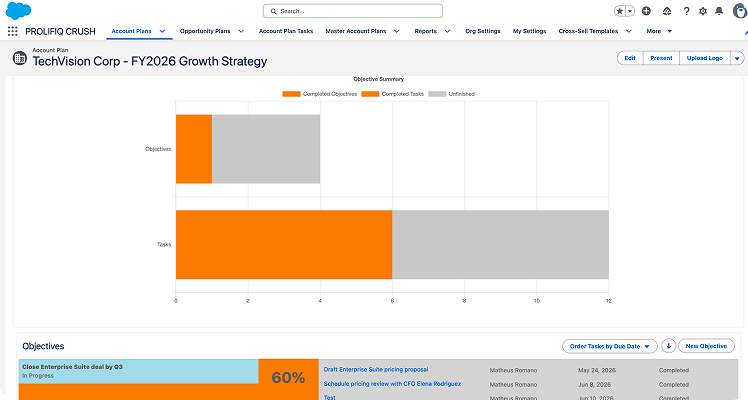
Strategy that turns into Salesforce tasks — automatically.

Objectives link to tasks with owners and due dates. Tasks appear in the assignee's standard Salesforce task list immediately — no plugin required. Key Dates handles mutual action plan milestones with automated email alerts.
Managers see plan health across every account without opening each one.

Plan scoring converts activity into a single health score per account — rewarding champion identified, buyer mapped, and Cross Sell complete. Managers see every account's score, trend, and risk status in one dashboard.

Global account directors get a single rollup — not 12 tabs to open.

Master Account Plans aggregate data from linked subsidiary plans — health score, 13-week trend, objectives, and relationships. Reps keep managing their own plans; the GAM sees the whole account without opening each one.

Multi-thread every complex deal — and see exactly who's been engaged before it's too late.

Opportunity Plans bring structured planning to individual deals. The Engagement Matrix auto-fills a buyer × seller grid from Salesforce activity, surfacing buying-committee coverage gaps without any new logging.

Know exactly who to engage on every account — champions, blockers, and everyone in between.

Every account plan includes a relationship map built from your existing Salesforce contacts — influence levels, support status, and relationship lines, visible alongside the rest of the plan. When a rep leaves, the map stays.

See exactly where you're winning, losing, and leaving money on the table — automatically.

The Cross Sell grid maps your products against every division: closed-won fills in automatically, open pipeline shows active opportunities, and the rest is visible whitespace — no manual tracking required.

Strategy that turns into Salesforce tasks — automatically.

Objectives link to tasks with owners and due dates. Tasks appear in the assignee's standard Salesforce task list immediately — no plugin required. Key Dates handles mutual action plan milestones with automated email alerts.

Managers see plan health across every account without opening each one.

Plan scoring converts activity into a single health score per account — rewarding champion identified, buyer mapped, and Cross Sell complete. Managers see every account's score, trend, and risk status in one dashboard.

Global account directors get a single rollup — not 12 tabs to open.

Master Account Plans aggregate data from linked subsidiary plans — health score, 13-week trend, objectives, and relationships. Reps keep managing their own plans; the GAM sees the whole account without opening each one.

Multi-thread every complex deal — and see exactly who's been engaged before it's too late.

Opportunity Plans bring structured planning to individual deals. The Engagement Matrix auto-fills a buyer × seller grid from Salesforce activity, surfacing buying-committee coverage gaps without any new logging.

See how CRUSH looks built in a Salesforce account.

Relationship maps, account plans, and whitespace — all on native Salesforce objects.

How Prolifiq Account Planning Works

CRUSH connects directly to your Salesforce account, contact, and opportunity data — no integration to build, no data to migrate.

Account planning software that adapts to how your team sells

CRUSH is configurable — sections, required fields, scoring criteria, and guidance text all flex by template, vertical, and selling motion.

Account plans

For AEs & SAMs managing strategic accounts
Account Hierarchy & Overview
Strategy & SWOT analysis
Cross-Sell Maps
Relationship Maps
PDF & Presenter View

Opportunity plans

For complex, multi-stakeholder deals
Relationship Map
Engagement Matrix
Supports any methodology
Opportunity Analysis
Activity Types

Master account plans

For global directors overseeing enterprise accounts
Aggregated account scores
Objectives (all)
Relationship Maps (all)
13-week trending
Account Opportunities (all)

Why CRUSH's account planning software is different

We win when teams actually adopt the product

Best-in-class onboarding

Most teams go live in the first two weeks — relationship maps and account overview first, objectives and scoring in a second phase — with dedicated onboarding included, not left to a help center article.

Deep customization

Plan templates are built by vertical, team, and selling motion — enterprise AEs, mid-market reps, and global account directors don't need the same plan. Choose which sections appear, what counts toward scoring, and what guidance reps see.

Exceptional support

The team that gets you live in two weeks stays with you as you expand — proactive support that catches a stalling plan before a QBR does.

Best-in-class onboarding

Most teams go live in the first two weeks — relationship maps and account overview first, objectives and scoring in a second phase — with dedicated onboarding included, not left to a help center article.

Deep customization

Plan templates are built by vertical, team, and selling motion — enterprise AEs, mid-market reps, and global account directors don't need the same plan. Choose which sections appear, what counts toward scoring, and what guidance reps see.

Exceptional support

The team that gets you live in two weeks stays with you as you expand — proactive support that catches a stalling plan before a QBR does.

Why CRUSH's account planning software is different

We win when teams actually adopt the product

Best-in-class onboarding

Get teams using the product fast so it becomes a daily habit, not shelfware.

Deep customization

Responsive, proactive help that keeps teams successful and drives retention.

Exceptional support

Responsive, proactive help that keeps teams successful and drives retention.

What impact we make

Average across teams using CRUSH.

+23%

Win rate improvement

‒26%

Sales cycle decrease

+25%

Cross Sell and upsell revenue

‒33%

New rep ramp time

Why revenue teams trust Prolifiq

Sales, RevOps, and key-account teams running their accounts inside Salesforce.
EXPANSION REVENUE & COMPETITIVE CAMPAIGNS
“The team is jazzed to say the least — it gives visibility into all cross-sell opportunities and an unprecedented level of intelligence into next-best actions and propensity to buy. We’ve already launched competitive take-away campaigns that are the most successful we’ve ever run.”
NL
Nicholas Ludy
Chief Growth Officer, A-LIGN
SCALE ACROSS A GLOBAL ENTERPRISE
“We grew from 450 to over 1,500 seats across multiple divisions and LATAM countries. Prolifiq scales with our most complex global deployments.”
BS
Boston Scientific
SALES OPERATIONS & CONSISTENCY
“CRUSH gives our sales operations team the structured account-planning framework we needed. It’s completely changed how we approach strategic accounts.”
GD
Geoff Downes
Director of Sales Operations, Parexel
EXPANSION REVENUE & COMPETITIVE CAMPAIGNS
“The team is jazzed to say the least — it gives visibility into all cross-sell opportunities and an unprecedented level of intelligence into next-best actions and propensity to buy. We’ve already launched competitive take-away campaigns that are the most successful we’ve ever run.”
NL
Nicholas Ludy
Chief Growth Officer, A-LIGN
SALES OPERATIONS & CONSISTENCY
“CRUSH gives our sales operations team the structured account-planning framework we needed. It’s completely changed how we approach strategic accounts.”
GD
Geoff Downes
Director of Sales Operations, Parexel

Account management software —
frequently asked questions

What is account management software?

Account management software helps revenue teams plan, manage, and grow their most important accounts — documenting account structure, strategy, relationships, and whitespace in one place. Prolifiq CRUSH is account management software built directly inside Salesforce, so every plan stays in sync with your CRM data automatically.

What is the best account management software for Salesforce?

CRUSH is account management software built 100% natively on Salesforce. Unlike tools that sync or integrate with the CRM, CRUSH runs on the Salesforce platform — so account plans, relationship maps, and whitespace analysis live where your team already works, with no integration required.

What is Salesforce account planning?

Salesforce account planning is the practice of building and maintaining structured strategic plans for key accounts directly inside Salesforce. With CRUSH, account planning in Salesforce means one native record per account — hierarchy, SWOT, cross-sell, relationships, and objectives — all reportable in your existing dashboards.

How is CRUSH different from other account management tools?

Most account management tools are a separate system that visualizes data. CRUSH is a native Salesforce data layer: every attribute — influence level, badge, objective, whitespace cell — is a reportable Salesforce object that rolls into scoring and dashboards. It’s not just another account management tool reps have to update; it reads from the data already in your CRM.

Is CRUSH really 100% native to Salesforce?

Yes. CRUSH is a managed package built on the Salesforce platform — not an integration. There’s no second login, no middleware, and no data sync. It inherits your existing permissions, reports, dashboards, and release cycles automatically.

Do reps have to rebuild their account notes from scratch?

No. CRUSH reads from the contacts, opportunities, and account records already in Salesforce. Account Hierarchy and the Cross-Sell grid populate automatically, so reps start from existing data rather than a blank slate.

How long does a CRUSH rollout take?

Most teams go live within the first two weeks. Because CRUSH is native to Salesforce, there’s no integration to build or data to migrate. A common approach is to launch relationship maps and the overview first, then add objectives and scoring in a second phase.

Can sales and customer success use the same account plan?

Yes. Plans are shared Salesforce records with team roles, permissions, and real-time Slack alerts, so sales, CS, and regional teams work from the same account strategy and handoffs don’t lose context.

Does CRUSH work with our existing Salesforce reports and dashboards?

Yes. Every field is a native Salesforce object, so all plan data — scores, objectives, relationships, whitespace — is reportable in your existing dashboards with no ETL required.

Who uses account management software like CRUSH?

Revenue teams managing complex, multi-stakeholder accounts — enterprise AEs, account managers, sales leadership, and customer success — especially in industries with long sales cycles and large buying committees like technology, healthcare, life sciences, financial services, and manufacturing.

See what account planning looks like when it actually lives in Salesforce.

Book a Demo